 iWeb Scraping
The online food delivery sector is still developing as digital connectivity improves. Changing consumer expectations are driving the adoption of app-based ordering and on-demand delivery services. The growing digital ecosystem has boosted demand for food delivery, quick commerce and other convenience services. Against this backdrop, the most popular restaurant aggregators such as Zomato and Swiggy have moved beyond restaurant delivery to invest in quick commerce, subscription programs, advertising and merchant solutions. The report examines their competitive landscape, business approach, operational performance, and future growth prospects, based on publicly available market intelligence.
Company and Business Model Overview
Zomato and Swiggy are digital enablers, food delivery platforms that connect consumers, restaurants, merchants, and delivery partners through technology-led ecosystems. Their main business model connects users with restaurants and delivers food to their doorsteps. Both food delivery platforms offer quick commerce, allowing consumers to buy groceries and daily essentials through the dedicated apps. They also use data analytics, artificial intelligence, and logistics optimization to improve the client experience, operational efficiency, and order fulfillment, while strengthening long-term client engagement and diversifying sources of income.
Zomato vs Swiggy: Difference At a Glance
The table mentioned clearly shows Zomato and Swiggy’s business positioning, their core strengths, strategic priorities, competitive advantages, and service diversification.
| Parameter | Zomato | Swiggy |
| Core Focus | Food Discovery | Food Convenience |
| Business Model | Marketplace Platform | Marketplace Platform |
| Quick Commerce | Blinkit | Instamart |
| Dining Services | Available | Available |
| Grocery Delivery | Blinkit | Instamart |
| Subscription | Zomato Gold | Swiggy One |
| Revenue Sources | Multi-Source | Multi-Source |
| Delivery Network | Partner-Based | Partner-Based |
| Merchant Solutions | Advertising Tools | Business Solutions |
| Technology | AI-Powered | AI-Powered |
| Customer Focus | Dining Experience | Convenience Services |
| Growth Strategy | Ecosystem Expansion | Service Diversification |
Revenue, Orders and Growth Performance
- Digital food delivery platforms are likely to still be measured by revenue growth, order growth and customer engagement in 2026.
- Zomato and Swiggy have also continued to expand their ecosystems with food delivery, quick commerce, subscriptions, advertising and merchant solutions.
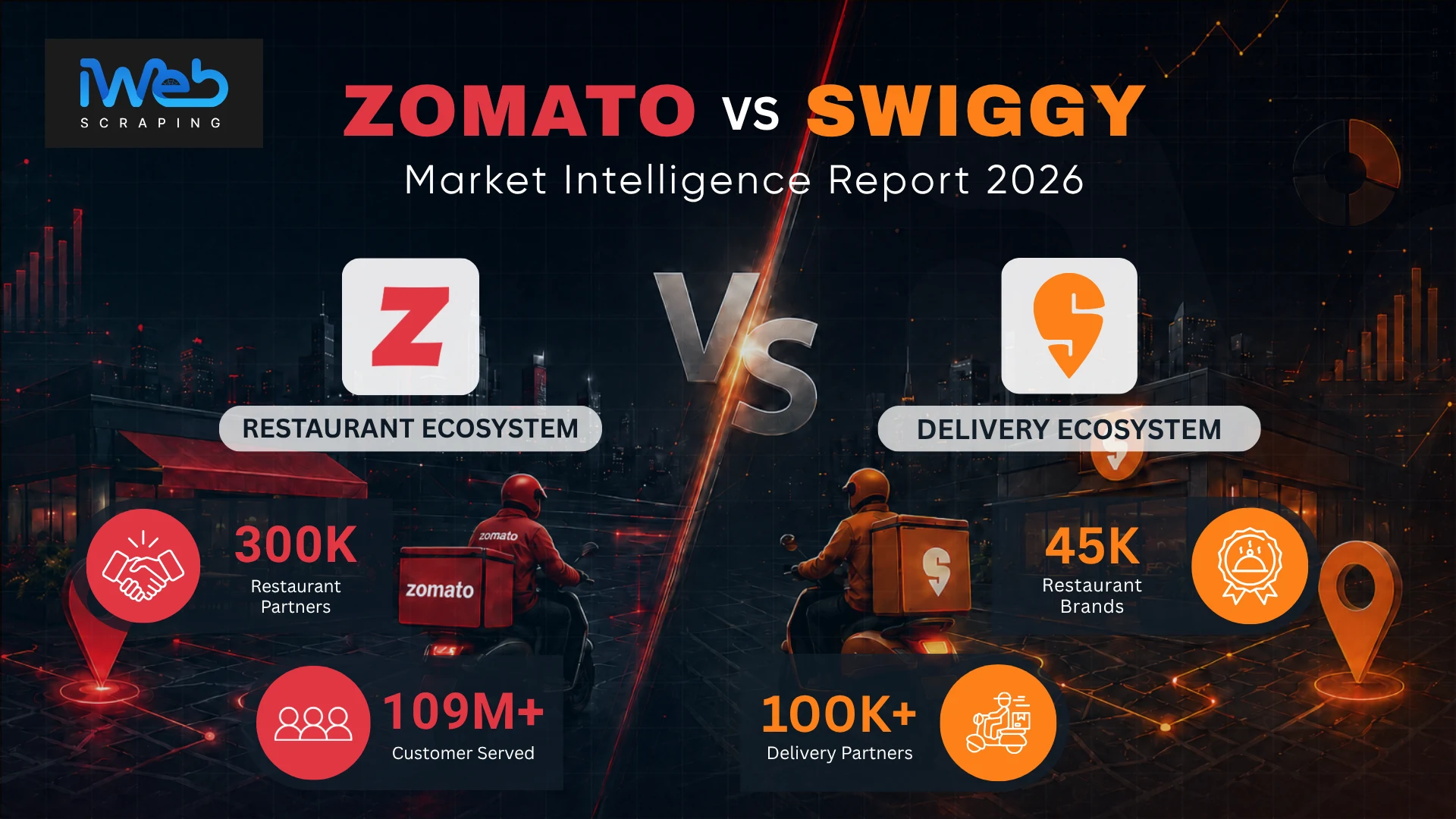
- In its FY2026 results, Eternal said its ecosystem processed transactions with an equivalent value in excess of $10 billion and 109 million customers transacted on its platforms during the year.
- B2C transaction value increased 54% year-over-year, demonstrating healthy consumer adoption and increased activity on the platform.
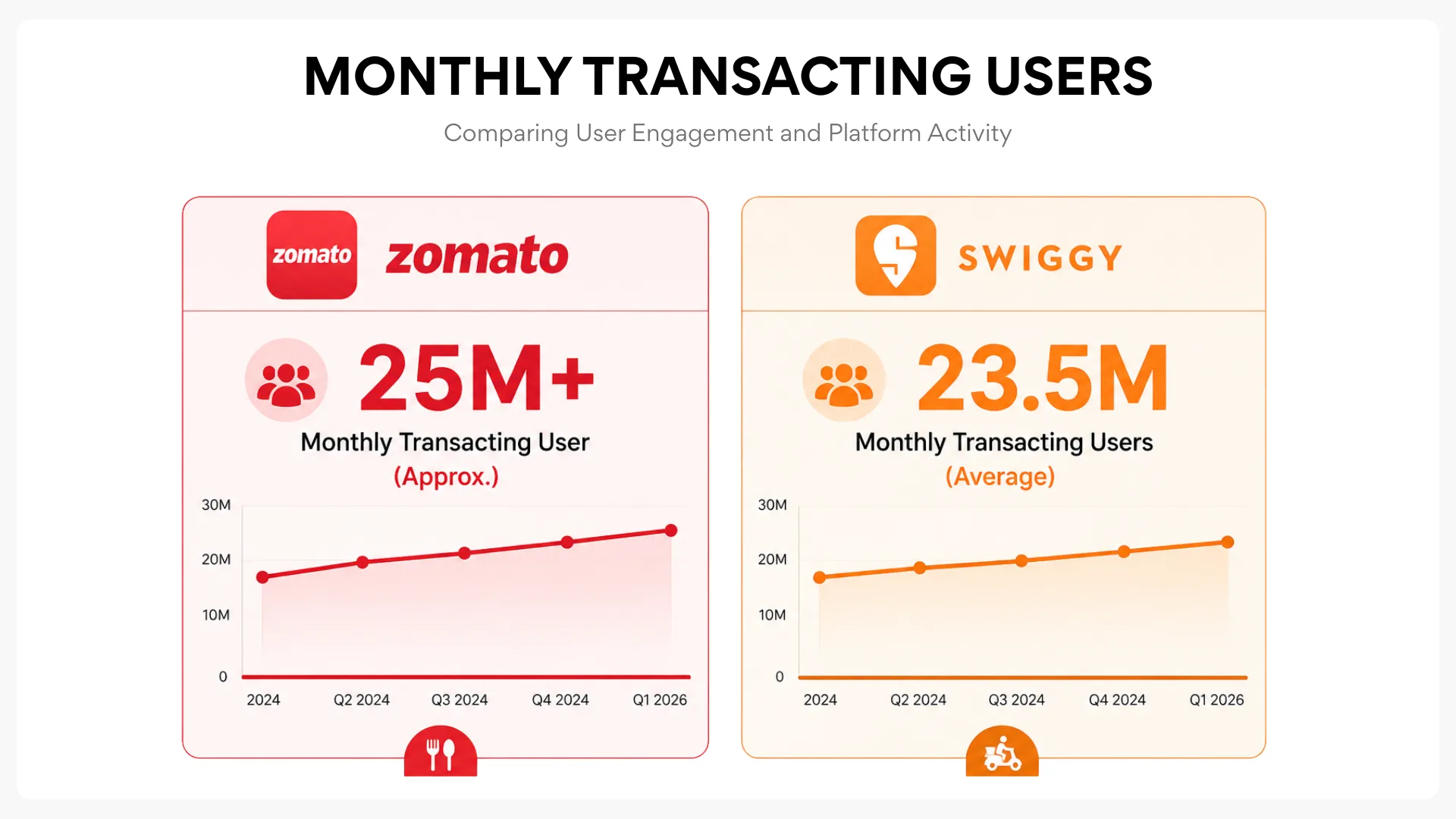
- Swiggy said its monthly transacting users on the platform grew 27.2% year-over-year to 23.5 million, indicating continued user growth and engagement.
Pricing and Monetization Intelligence
The pricing and monetization strategies are key to the competitiveness and profitability of digital food delivery platforms. Zomato and Swiggy operates dynamic pricing, which fluctuates with demand and considers the distance of delivery, the value of the order and the customer’s interaction with the service. Subscription programs can help keep customers loyal by providing benefits like lower fees and special deals, and advertising services can result in new revenue streams from restaurant partners. The competition is heating up, and both platforms have a core strategic focus on delivering affordable food to customers, while still carrying sustainable margins.
Restaurant Network and Merchant Intelligence
Restaurant partnerships are a key driver of food delivery platforms, enabling greater customer choice, better service availability, and stronger marketplace growth. In 2026, Zomato (Eternal) reported 300,000+ average monthly active food delivery restaurant partners, serving 900+ cities and supporting 25+ million average monthly transacting customers. These figures highlight the platform’s strong merchant network, broad geographic reach, and high level of customer engagement.
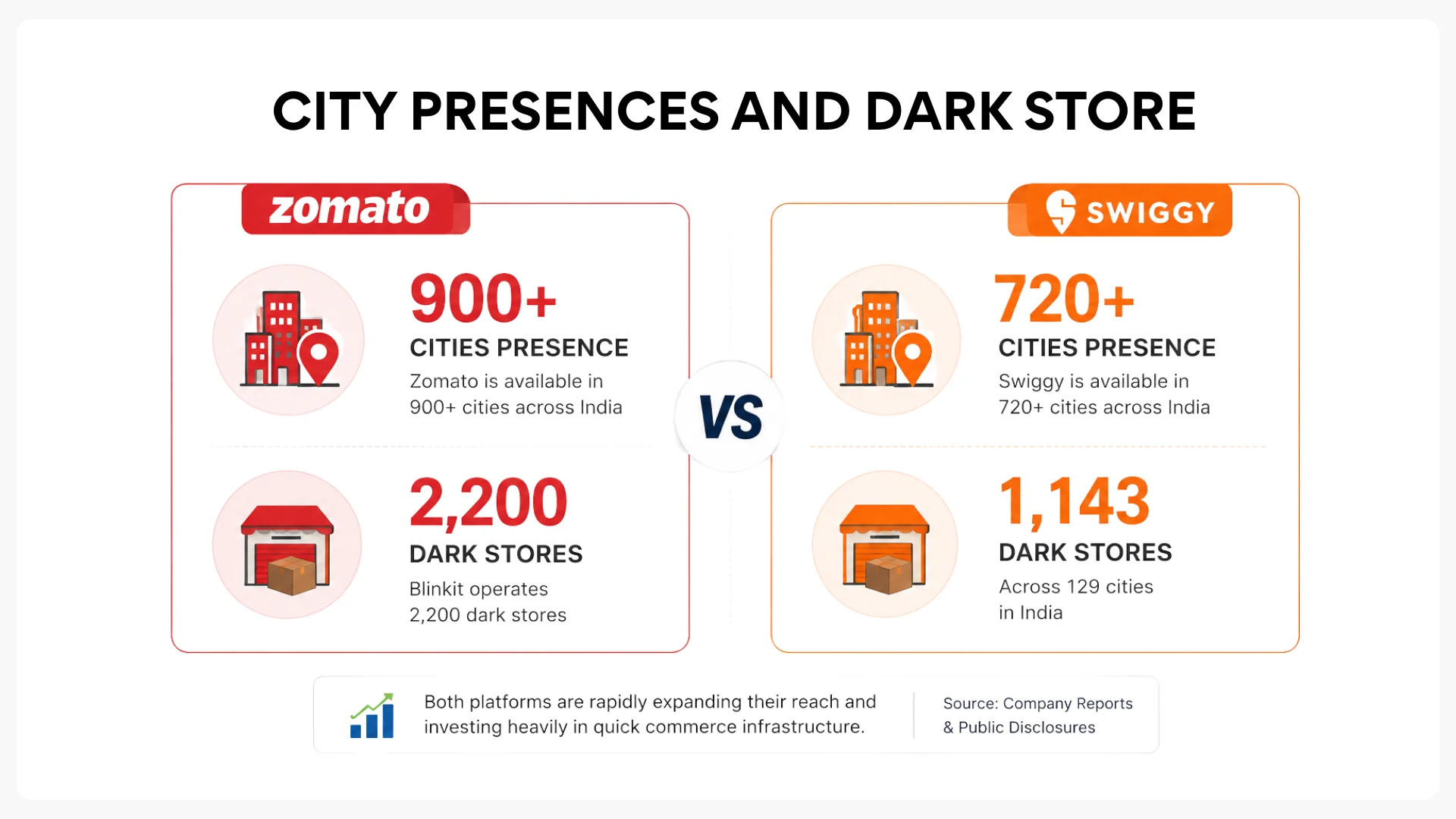
The company’s platform continues to connect restaurants, customers and delivery partners with technology-enabled solutions. Swiggy’s last reported network stands at 45,000+ restaurant brands across 720+ cities, supported by merchant-centric products such as advertising solutions and digital storefront services. The restaurant ecosystem is large enough to enable better assortment, more frequency of orders and more monetization opportunities.
Delivery Performance and Customer Experience
In 2026, delivery performance and customer experience remain the key competitive differentiators for Zomato and Swiggy. Both platforms have vastly improved logistics efficiency with AI-based route optimization, demand forecasting and wide networks of delivery partners, while adopting different strategic priorities to boost customer satisfaction. Let us consider the various factors included in it.
Delivery Speed
For Zomato and Swiggy, the delivery speed is one of the key competitive factors as customers now demand fast and reliable food ordering. Both food delivery platforms have invested in AI-route optimization, real-time order tracking, and efficient logistics networks to cut down on delivery times.
Swiggy also offers fast delivery through a robust network of delivery partners and a quicker dispatch system. Zomato has been investing in logistics technology and operations to make the delivery process a lot more efficient.
Both food aggregators have always tried to deliver food as quickly as possible and maintain high food quality and customer satisfaction. As a result, the difference in delivery speed between the two platforms has become much smaller than it was in the past.
Customer Experience
Zomato focuses on helping users discover and decide restaurants by providing rich information such as menus, customer reviews, ratings, food pictures, and dining recommendations. This allows customers to make informed choices and improves their overall ordering and dining experience.
Swiggy is for users who are looking for speed and day-to-day convenience. Its user-friendly interface, fast order processing, and other services like Instamart and Genie make an ecosystem where consumers can satisfy several daily needs on a single platform.
Customer Support
Zomato and Swiggy provide support via in-app assistance, automated solutions, and problem-solving services. While their goals are identical, they differ in speed, response, and quicker delivery issue resolution times. Zomato focuses on corporate accountability and customer feedback, whereas Swiggy’s support infrastructure is built to ensure that issues are resolved quickly to maintain strong customer relationships.
Technology, Data and AI Capabilities
Swiggy and Zomato both faced challenges in last-mile delivery. These food delivery platforms utilize AI-powered navigation systems that are integrated with Google Maps and in-house API. It includes some unique features such as:
- Avoiding congested routes
- Re-routing in case of a roadblock
- Suggesting the shortest delivery path
AI-powered food delivery system gathers data from previous records to enhance its accuracy. These intelligence agents get smarter at predicting delivery ETAs, road closures, festival rush, and even rain over time. Both Swiggy and Zomato have modern logistics systems that continuously calculate:
- Route efficiency
- Rider distribution
- Predicted delivery times
SWOT Analysis of Zomato and Swiggy
SWOT Analysis of Zomato
Zomato’s strengths include strong brand presence, large restaurant network and technology driven services. Its weaknesses include high competition and operational costs. Quick commerce and digital expansion represent some of its opportunities. The main threats are competition in the market and changes in customer preferences.
SWOT Analysis of Swiggy
Swiggy’s strengths include a strong delivery network, logistics capabilities and customer-centric services. It’s challenges include high operating expenses and profitability pressure, while growth opportunities are in new markets and quick commerce. Competition and increasing delivery costs remain major threats.
Future Market Outlook
The online food delivery and quick commerce market is projected to grow from USD 355.6 billion in 2026 to USD 505.5 billion by 2030 (9.4% CAGR), driven by changing consumer preferences, digital innovation, and a wider array of service offerings.
Zomato and Swiggy are expected to increase market share through investments in technology and operational efficiency and diversifying business models. The competition in the future will be less about price competition and more about profitability, customer experience and expanding the ecosystem.
Conclusion
The market intelligence analysis also underlines that Zomato and Swiggy are still the top players in the online food delivery and quick commerce industry competing on innovation, service quality and operational excellence. Both companies have expanded their business beyond food delivery and are investing in fast commerce, digital technology and customer-centric solutions to strengthen their competitive position.
Zomato is holding its own on back of profitability and growing its ecosystem while Swiggy is gaining market-share through diversified service portfolio and strategic investments. Looking forward, continued growth will be driven by ongoing improvements in technology, operating efficiencies, customer retention and business diversification. In a market with evolving consumer needs, both companies are well positioned to spur innovation and help define the future of the digital commerce ecosystem.