 Vani Shah
How many Albertsons locations are there in the USA in 2026, and which states have the most stores? The answer depends on whether you mean the Albertsons grocery banner or the broader Albertsons Companies network.
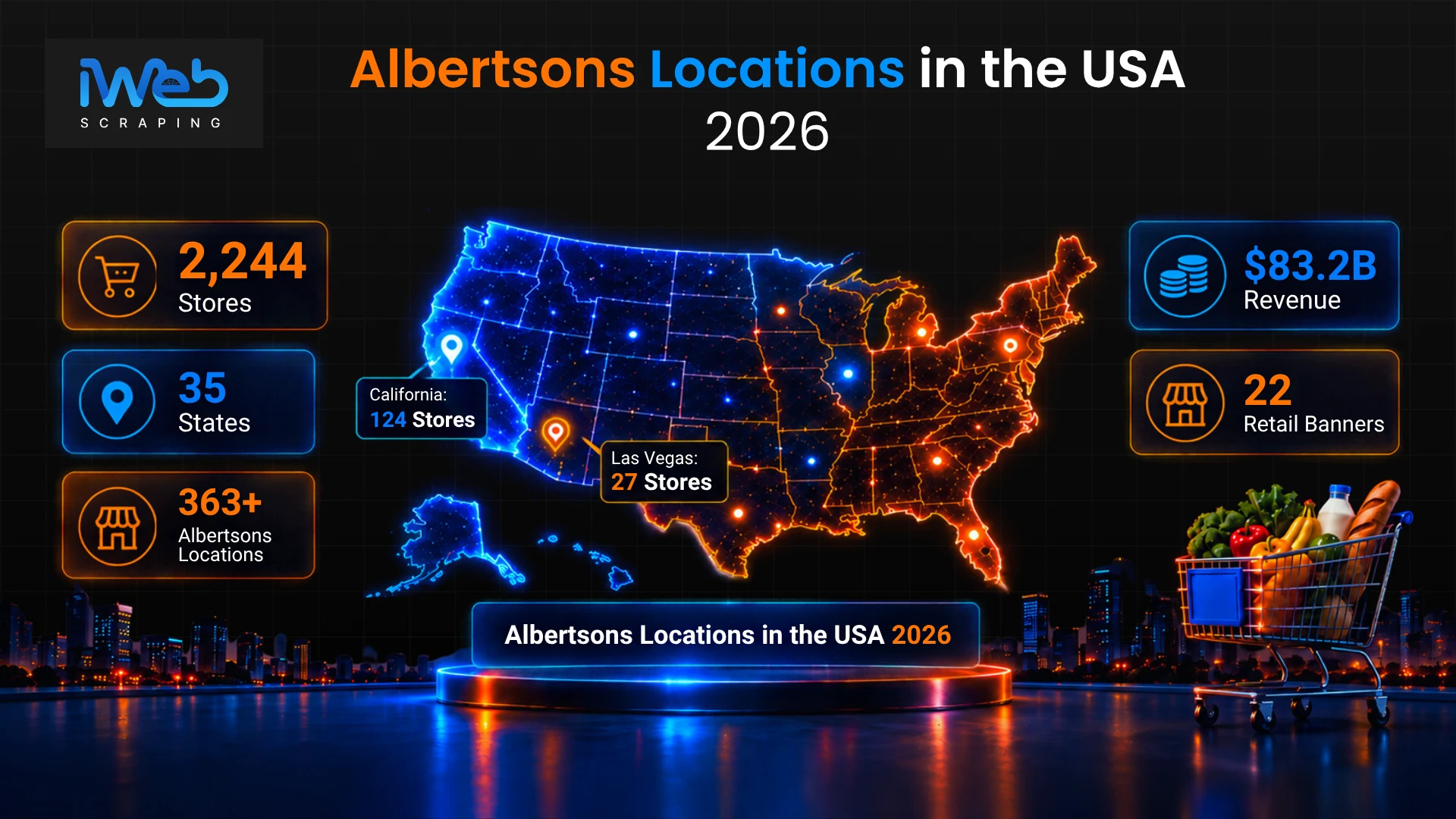
The Albertsons banner has roughly 363–368 locations across about 16 states, based on recent location data. By comparison, Albertsons Companies operated 2,244 retail stores across 35 states and the District of Columbia as of February 28, 2026, including multiple banners such as Safeway, Vons, and Jewel-Osco.
This blog breaks down the 2026 Albertsons store count by state and city, explains why store totals can vary between sources, and examines the company’s broader retail footprint. Whether you are researching grocery competition, analyzing retail locations, or looking for current Albertsons stores in the USA, you will find the key figures and context in one place.
How Many Albertsons Locations Are There in 2026?
The Albertsons grocery banner has approximately 363–368 locations across about 16 states in 2026, based on recent location datasets. Because stores can open, close, or change banners, the exact count depends on the date and source used. That figure drifts a little by tracking date, since stores open, close, or rebrand throughout the year. The broader Albertsons Companies network is substantially larger because it includes multiple grocery banners beyond Albertsons.
The two figures measure different things:
- Albertsons banner: Approximately 363–368 stores across about 16 states.
- Albertsons Companies: 2,244 retail stores across 35 states and the District of Columbia as of February 28, 2026.
According to the company’s own fiscal 2025 results filed with the SEC, that 2,244-store network also includes 1,713 in-store pharmacies and 405 fuel centers. So the correct answer to “how many stores?” hinges on whether someone means the single banner or the whole family of brands. Using the correct figure is essential for retail location analysis because the Albertsons banner count and the Albertsons Companies footprint represent different levels of the business.
Which States Have the Most Albertsons Stores?
California dominates the map. The state holds about 123 to 124 Albertsons locations, close to a third of the entire single-banner network. That weight reflects the brand’s western roots and dense metro demand. Texas, Idaho, and Nevada follow, and after that the footprint thins out quickly.
The table below shows the estimated number of Albertsons banner locations by state based on recent location datasets. Because store openings, closures, and rebranding can change the footprint, these figures should be treated as date-specific rather than permanent totals.
| Rank | State | Albertsons Locations |
| 1 | California | 124 |
| 2 | Texas | 43 |
| 3 | Idaho | 37 |
| 4 | Nevada | 35 |
| 5 | Montana | 31 |
| 6 | Arizona | 30 |
| 7 | Oregon | 24 |
| 8 | Louisiana | 16 |
| 9 | Washington | 16 |
| 10 | Wyoming | 10 |
| — | Other states | Remaining locations |
The listed states account for 366 locations in this dataset; the broader 2026 total can vary slightly depending on the collection date and methodology.
Idaho stands out for its unusually high Albertsons store density relative to its population, illustrating why store count alone does not fully describe a retailer’s geographic presence, the tightest coverage of any state on the list. California, by contrast, serves roughly one store per 319,000 people, showing how population size and store density are not the same thing.
Which Cities Lead in Albertsons Locations?
Albertsons locations are concentrated in several western and southwestern cities, with Las Vegas, Boise, and El Paso among the largest city-level clusters in the available location data. Las Vegas sits at the top, hosting more stores than any other single city. These clusters confirm how the brand leans into western and southwestern markets.
The leading cities for Albertsons store locations break down as follows:
- Las Vegas, Nevada — around 27 stores.
- Boise, Idaho — about 13 stores.
- El Paso, Texas — roughly 8 stores.
- Bakersfield, California — about 7 stores.
- Fort Worth, Texas — around 7 stores.
- Billings, Montana — roughly 7 stores.
- Baton Rouge, Louisiana — about 7 stores.
The city-level distribution shows a strong presence in western and southwestern markets, although city counts should not be interpreted as metro-area market share. Instead, the brand thrives in mid-sized western cities where it has held ground for decades. This pattern matters for anyone doing grocery market analysis or planning regional distribution.
Albertsons Companies Store Count and Retail Footprint
The Albertsons banner represents only one part of Albertsons Companies’ broader retail portfolio. Albertsons Companies, Inc. (NYSE: ACI) ranks among the largest food and drug retailers in the country, and its scale tells a different story than the standalone count.
Drawing on the company’s fiscal 2025 report, which ended February 28, 2026, the parent-company footprint looks like this:
- Retail stores: 2,244 nationwide.
- In-store pharmacies: 1,713 across the network.
- Fuel centers: 405 associated sites.
- Supply chain: 22 distribution centers and 19 manufacturing plants.
- Reach: 35 states plus the District of Columbia.
The group operates 22 well-known banners, which is exactly why the parent count towers over the single brand. The company’s portfolio includes banners such as:
Albertsons, Safeway, Vons, Jewel-Osco, Shaw’s, ACME, Tom Thumb, Randalls, United Supermarkets, Pavilions, Star Market, Haggen, Carrs, Kings Food Markets, and Balducci’s.
On the financial side, the company posted annual revenue near $83.2 billion for fiscal 2025, up about 3.5% year over year, with digital sales climbing 21% and loyalty membership reaching 51.2 million. Employee headcount sat around 280,000. Those figures, pulled from ACI’s public earnings release, give any retail data project a verified, first-party foundation.
How Is Albertsons Location Data Collected and Verified?
Building an accurate Albertsons locations dataset typically involves collecting, standardizing, validating, and periodically refreshing store records from multiple sources. A reliable Albertsons locations dataset comes from a few careful steps, and knowing those steps helps you judge which numbers to trust.
- Source collection
Official store locators, corporate filings, and reputable location databases are reviewed. - Address normalization
Store addresses are standardized to reduce duplicate or inconsistent records. - Location validation
Coordinates, city, state, ZIP code, and store status are checked. - Banner classification
Albertsons stores are separated from other Albertsons Companies banners such as Safeway and Vons. - Deduplication
Duplicate listings and outdated records are removed. - Refresh and monitoring
The dataset is periodically updated to capture openings, closures, relocations, and rebranding.
Two soft spots explain why published totals vary from one source to another. First, tracking dates differ, so a March count will not match a July count. Second, some reports mix the single banner with the parent group. Knowing this lets you compare figures fairly instead of assuming one is simply wrong. For businesses that need continuously refreshed retail location data, automated data collection can help maintain a more current view of store openings, closures, and geographic coverage. Businesses that need custom retail datasets can use automated web scraping and data extraction workflows to collect and maintain location-level information at scale.
Who Uses Albertsons Store Data, and Why?
The 2026 Albertsons store data serves very different readers, and each one leans on current, structured numbers for a distinct purpose.
Consider the main groups that benefit:
- Shoppers who just want the nearest store, pharmacy, or fuel center.
- Market researchers track grocery density, coverage gaps, and local competition.
- Suppliers and brands rely on it to plan distribution across western and southwestern regions.
- Real estate teams compare footprints before they sign a new lease.
- Analytics firms feed the data into their own location-intelligence products.
Because the count moves quarter to quarter, leaning on a single dated article can skew an entire project. Fresh, clean store location data keeps decisions grounded, and that is the core of what our retail-data team delivers.
How Does Albertsons Compare With Other Major U.S. Grocery Chains?
Store count means more once you place Albertsons next to its competitors. Walmart dwarfs everyone, Kroger operates a larger U.S. store network than Albertsons Companies, although the two companies differ in banner structure and geographic concentration, and Safeway is not a competitor at all, since Albertsons owns it.
| Chain | Approx. U.S. Store Count | Business Model |
| Walmart | 4,600+ | Supercenters, grocery & other formats |
| Kroger | ~2,700 | Supermarkets |
| Albertsons Companies | 2,244 | Multiple grocery banners |
| Publix | ~1,467 | Supermarkets |
Figures are approximate and reflect 2026 reporting.
Kroger is the closest match, running about 2,700 stores to Albertsons’ 2,244. The proposed Kroger–Albertsons merger was blocked in 2024, highlighting the scale and competitive significance of the two grocery groups. Walmart plays a different game with groceries bundled into massive supercenters, while Albertsons wins on regional strength, pharmacies, and loyalty.
The key point on Safeway: it is one of 22 banners under Albertsons Companies, so counting it separately double-counts the same firm. That is why the parent count of 2,244 towers over the single banner of roughly 363 to 368.
Quick Facts at a Glance
For a fast recap, here are the essential Albertsons 2026 figures in one place:
- Albertsons banner: ~363–368 locations
- Albertsons Companies: 2,244 retail stores
- States with Albertsons banner locations: ~16
- States with Albertsons Companies stores: 35 + Washington, D.C.
- Largest Albertsons state: California
- Largest city cluster: Las Vegas, based on the cited dataset
- Fiscal 2025 revenue: ~$83.2 billion
- Albertsons Companies banners: 22
These points hand you the whole story at a glance, whether you are a curious shopper or a working retail data analyst.
Conclusion
The 2026 Albertsons footprint is best understood at two levels. The Albertsons grocery banner has roughly 363–368 locations across about 16 states, while Albertsons Companies operates a much broader network of 2,244 retail stores across 35 states and the District of Columbia. Keeping these figures separate prevents the most common source of confusion when analyzing Albertsons locations.
At the banner level, California has the largest concentration of stores, while western and southwestern markets account for much of the company’s geographic presence. For retailers, suppliers, researchers, and real estate teams, however, the value of this information goes beyond a simple store count. Location-level data can reveal geographic coverage, competitive gaps, distribution opportunities, and changes in a retailer’s footprint over time.
Because stores open, close, relocate, and change banners, a useful retail location dataset needs to be regularly validated and refreshed. Businesses that need current store-level information can use automated data collection and structured location datasets to support ongoing retail and market analysis.

 iWeb Scraping
Read Time: 9 min
iWeb Scraping
Read Time: 9 min