 iWeb Scraping
National market share data is a vanity metric. Citing that DoorDash controls roughly 67% of the U.S. food delivery landscape provides zero actionable value to a restaurant operator in Manhattan or a ghost kitchen investor in Chicago. Relying on broad macro-data creates a dangerous blind spot for commercial strategy.
The core problem is simple: brands misallocate local advertising budgets and select expansion sites based on national averages. A strategy built for a DoorDash-dominated suburb will fail completely in an urban neighborhood ruled by Grubhub. Macro-reports completely ignore hyper-local realities, zoning laws, and entrenched regional consumer habits.
To win locally, your business must move past static, outdated PDF reports. The solution lies in automated web scraping. Extracting live menu prices, real-time merchant densities, and fluctuating delivery fees directly from delivery app interfaces provides immediate market clarity. Granular, scraped data transforms guesswork into a precise, localized expansion playbook.
The Current Landscape: National vs. Regional Dominance
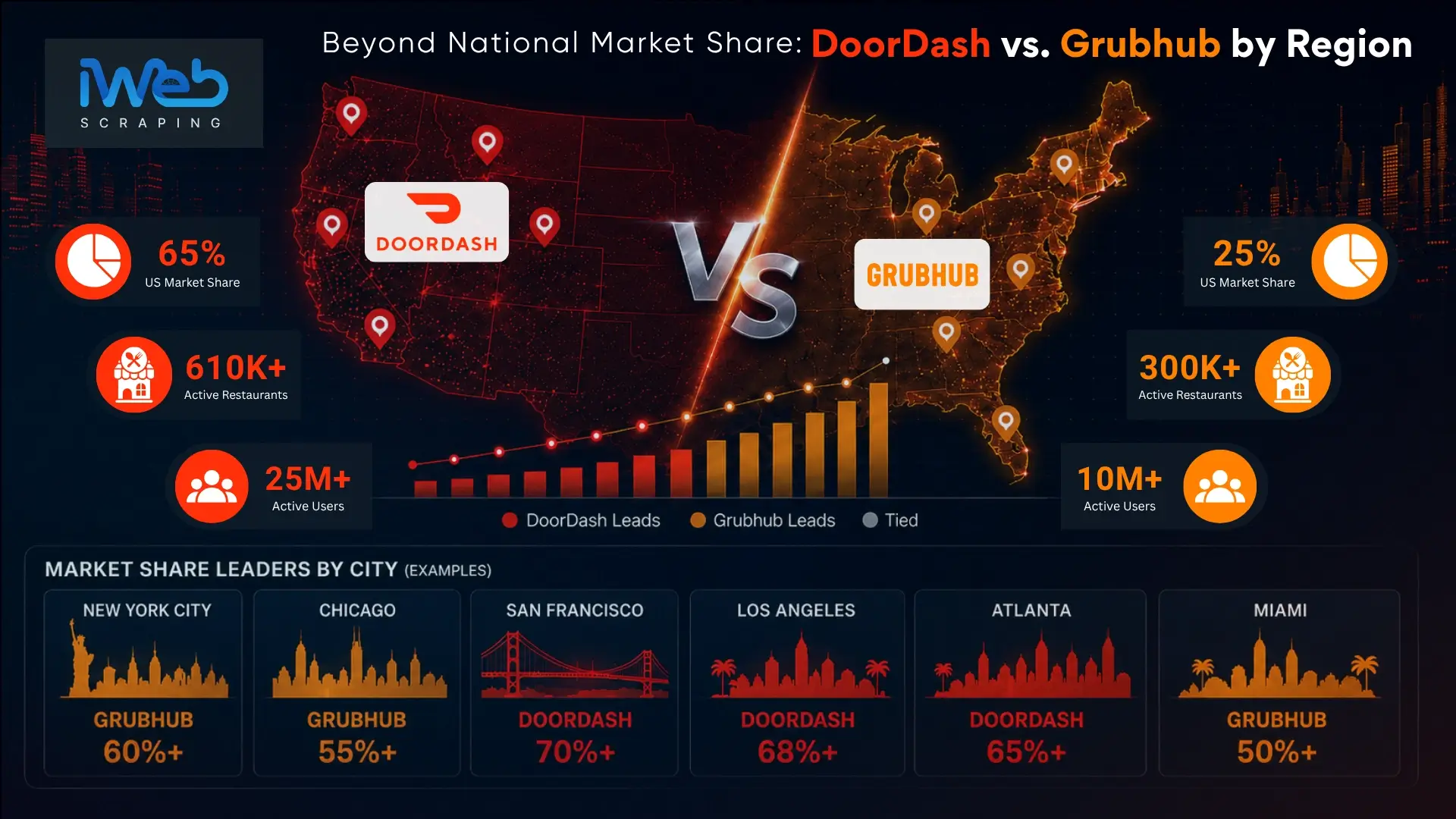
Food delivery apps compete zip code by zip code, not state by state. The table below breaks down how market dominance splits across major American hubs and suburban landscapes.
| City / Region | Dominant App | Est. Market Share | Primary Local Driver |
| New York City | Grubhub / Seamless | ~38% – 42% | Entrenched corporate B2B accounts and early independent merchant adoption. |
| San Francisco | DoorDash | ~72% – 75% | Silicon Valley home-turf advantage and dense suburban-fringe coverage. |
| Chicago | DoorDash | ~55% | Strong suburban migration and aggressive local chain exclusivity deals. |
| Miami | Uber Eats | ~52% | High tourism density, luxury hotel integrations, and urban commuter habits. |
| U.S. Suburbs / Midwest | DoorDash | ~70%+ | Early-mover logistical strategy targeting multi-car family households. |
Who Wins in New York City?
Grubhub maintains its tightest grip on the United States market within the New York City metropolitan area. This structural dominance stems from its early acquisition of Seamless, which locked in lucrative corporate catering and office lunch accounts across Manhattan.
NYC’s extreme vertical density minimizes the need for vehicular delivery networks. Grubhub’s legacy network of walking and biking couriers seamlessly integrates with independent, family-owned restaurants that resisted transitioning to newer platforms.
Who Rules the Suburbs and Midwest?
DoorDash completely rules the American suburbs and the Midwest. While competitors spent years fighting for expensive urban real estate, DoorDash focused heavily on geographic expansion into secondary and tertiary markets.
Suburban regions present higher average order values (AOV) due to larger family-sized meals. DoorDash optimized its logistics for vehicular travel, securing sprawling residential zip codes where consumers prioritize convenience over brand loyalty. This suburban dominance forms the foundation of its national market share lead.
How the Giants Fight for Zip Code Dominance
National footprints mean nothing if a competitor controls the three-mile radius around your kitchen. DoorDash and Grubhub deploy aggressive, hyper-local tactics to secure individual neighborhoods and lock down consumer spending.
Winning a region comes down to mastering three specific structural battlegrounds.
Exclusive Restaurant Partnerships
Platform loyalty starts with food exclusivity. Apps actively lock down dominant local chains and regional favorites through tier-one merchant agreements.
If a high-volume local burger chain or a beloved regional taco franchise signs exclusively with DoorDash, thousands of neighborhood customers are forced onto that specific app. This creates a massive barrier to entry.
For competing apps, losing these anchor merchants instantly degrades their local value proposition and shrinks their active user base within that zip code.
Subscription Bundle Competition (DashPass vs. Grubhub+)
The real battle for customer lifetime value (LTV) is fought through subscription ecosystems. DashPass and Grubhub+ use recurring monthly fees to eliminate delivery charges for consumers, effectively locking in their ordering habits.
- DashPass scales aggressively by bundling its service with premium American credit cards (like Chase). This hooks high-income suburban households.
- Grubhub+ counters through strategic corporate alliances, including its massive partnership with Amazon Prime, giving millions of users free access.
Once an American consumer activates a delivery subscription, their platform loyalty becomes absolute. They rarely cross-shop on competing apps, dictating exactly where regional order volumes flow.
The Real-Time Data Gap
The biggest mistake operators make is treating local market metrics as permanent fixtures.
In reality, delivery landscapes are incredibly volatile. Zip code dynamics shift on a weekly basis. A competitor might launch a targeted 20% off promotion, a top-tier local restaurant might break its exclusivity contract, or a platform might quietly shrink its delivery radius due to courier shortages.
Static, quarterly industry reports cannot capture these micro-fluctuations. Relying on outdated PDFs means your business is navigating a real-time war with a map from last year.
How to Use Web Scraping to Uncover Hyper-Local Food Delivery Data
Winning a local delivery market requires a continuous, unfilterable data stream. You cannot build a modern growth strategy on guesses or high-level summaries.
To outmaneuver competitors, businesses must leverage automated data extraction. Web scraping bypasses generic platform dashboards, pulling raw, unfiltered intelligence straight from delivery app interfaces.
Implementing a structured web scraping framework delivers immediate, actionable operational advantages across three core pillars.
Competitor Pricing Audits
Automated food delivery data scraping extracts exact menu prices, delivery charges, and discount offers from competing DoorDash and Grubhub restaurants within a three-to-five-mile radius, enabling real-time competitor pricing intelligence.
This continuous data feed reveals hidden inflation patterns and sudden price shifts. Restaurants use this insight to implement dynamic pricing models, matching local market tolerances and optimizing profit margins without sacrificing order volume.
Zip Code Mapping
Scraping uncovers hidden logistical friction points by tracking delivery fees, service surcharges, and estimated fulfillment times across specific neighborhoods.
Mapping these variables isolates underserved zip codes where delivery times are sluggish or fees are artificially high. These gaps pinpoint high-yield territories ripe for low-risk virtual kitchen expansion.
Lead Generation for B2B Vendor Growth
For B2B companies such as sustainable packaging suppliers, localized marketing agencies, and restaurant SaaS providers delivery platforms are live directories of high-intent prospects.
Scraping scripts flag newly onboarded storefronts on DoorDash and Grubhub the moment they go live. This creates an automated, refreshed list of hot sales leads before competitors even know they exist.
Maximizing Ghost Kitchen Margins via Live Data
To understand the real-world power of automated data extraction, look at how a multi-location virtual kitchen brand used automated data to reclaim its slipping profit margins.
Operating across twelve dense zip codes in Chicago and Boston, the brand faced intense competition from surrounding digital storefronts.
The Challenge: Hidden Underpricing
The brand originally reviewed competitor menus manually once a month.
However, local competitors began utilizing dynamic pricing frequently altering their delivery fees, combo pricing, and item modifiers every Friday afternoon to capture weekend surge demand.
Because the brand relied on static data, they were consistently underpricing their premium items during peak hours, missing out on thousands of dollars in high-margin revenue.
The Scraping Solution
The company deployed our custom DoorDash menu scraping API to automate their competitive intelligence.
Every Friday at 2:00 PM, the script crawled a three-mile radius around each kitchen location, extracting:
- Exact menu pricing for top-competing items
- Fluctuating local delivery fees
- Active promotional tags (e.g., “Buy 1, Get 1”)
The Result: A 14% Margin Increase
The scraped data revealed that competitors regularly raised chicken wing and premium burger prices by 8% to 12% on weekends to offset high platform commission fees.
Armed with this live intelligence, the virtual kitchen brand integrated the data feed into their own POS system. They automated a weekend pricing structure that closely matched regional market tolerances.
Within 90 days of launching the automated scraping workflow, the brand achieved a 14% net increase in delivery profit margins across all twelve locations, completely eliminating manual market research.
Conclusion: Stop Guessing Your Local Market Share
DoorDash may capture the national headlines with its massive U.S. market share, but local victory belongs entirely to the business that owns the granular, regional data.
Food delivery is a neighborhood-by-neighborhood battle where consumer preferences, competitor pricing, and platform dominance shift weekly. Relying on outdated macro-reports to guide your business strategy is no longer a viable option.
To scale your restaurant brand, optimize your ad spend, or capture B2B leads, you need live, hyper-local data. Automated web scraping removes the guesswork, giving you a transparent view of exactly what is happening in your target zip codes.