























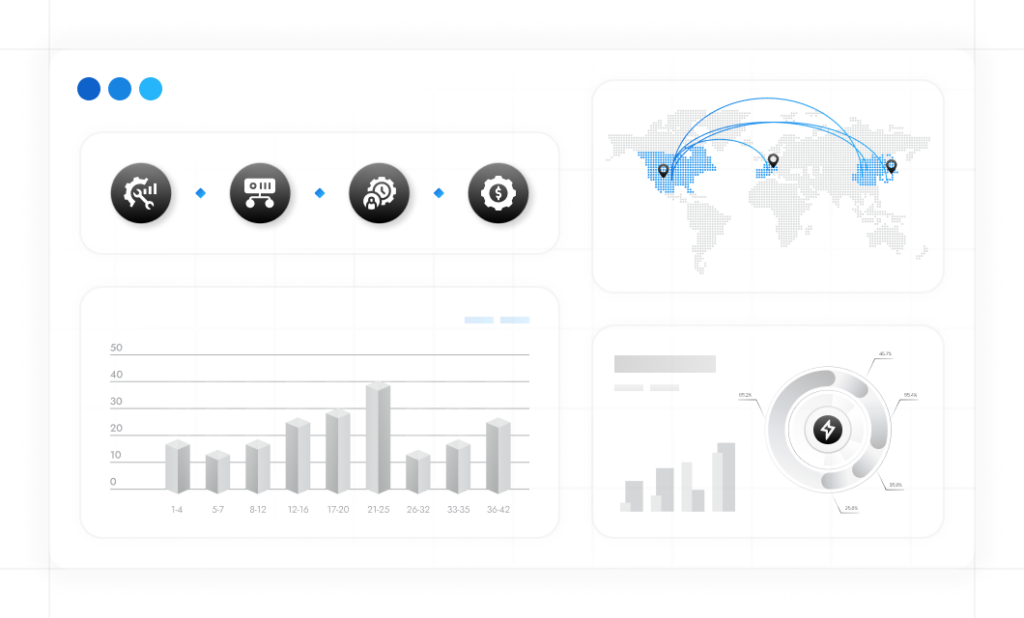
Real-Time Energy & Utilities Data Scraping for Reliable Industry Insights
Custom web scraping solutions to track competitors, monitor prices, analyze market trends, and gather product intelligence at scale.


Trusted by Global Technology Leaders
Custom Energy & Utility Data Intelligence for Market Advantage
Energy and utilities scraping allows organizations to gather and analyze publicly available datasets in real time from power exchanges, utility companies, renewable energy platforms, regulatory agencies, commodity exchanges, and infrastructure directories. This information could contain; energy pricing trends, energy production levels, grid performance updates, regulatory filings, and market activity signals. With that being said, iWeb Scraping converts complicated energy datasets into structured intelligence to facilitate pricing strategy analysis, competitive benchmarking, demand forecasting and strategic decision making on a global level.
What Is Energy & Utilities Data Scraping?
Energy and utilities data scraping is the systematic collection of publicly available information from various different fields. This includes power exchanges and utility company websites. It also includes renewable energy platforms, oil and gas portals, regulatory bodies and infrastructure directories. Now post the extraction of information from these sources it will be structured. This structuring will be done in such a manner to create datasets that will allow energy companies, analysts, traders, and investors to track markets. It will also further allow them to analyze competition and make data-based decisions.
Benefits of Energy & Utilities Data Scraping
Data harvesting for the energy and utilities sector allows companies to use structured, live market intelligence to allow them to make informed decisions.
Real-Time Energy Pricing Intelligence
Keep track of the price of electricity and the fluctuations of commodities in real-time. One can also keep a tap across all energy markets to identify price gaps.
Renewable Energy Trend Monitoring
Monitor publicly available data of the energy related projects, among others. This can be done to analyze capital flow and regional adoption trends of clean energy markets.
Regulatory & Policy Intelligence
Gather updates from regulatory agencies regarding changes to compliance and announcements of new subsidies. This will help analyze the way you do business and enter a new market.
Utility Provider Benchmarking
Provide a basis to compare service offerings across utility companies. This will be done to enable you to evaluate how you stand competitively and against your market.
Infrastructure Expansion Monitoring
Find out about new power plants or plant expansions. This will enable you to identify emerging patterns in the development of infrastructure.
Automated Large-Scale Data Collection
By collecting data from many data sources, you will eliminate manual data collection. This provides you with a reliable process to continue receiving updates on various energy-related sources.
Key Use Cases of Energy & Utilities Data Scraping
Energy and utility data scraping transforms considerable amounts of publicly accessible data into actionable intelligence across many different industry applications.
Energy Pricing & Market Intelligence
Structurally monitor energy price trends, tariff updates, commodity fluctuations and market volatility, and more to inform decision-making around trading, purchasing and creating competitive positions.
Wholesale Power Price Monitoring
By examining wholesale electricity prices across different markets, you can identify volatility trends, regional price differentials and arbitrage opportunities that may inform how you purchase and trade.
Retail Tariff Benchmarking
By comparing residential, commercial and industrial retail tariffs across utilities, you can assess their relative competitive position in your region and their affordability and competitiveness for customer acquisition.
Fuel & Commodity Price Tracking
By tracking oil, gas, coal and fuel prices in the global marketplace, you can assess upstream price fluctuations and cross-commodity price relationships in order to better understand energy supply chain costs.
Regulatory & Compliance Intelligence
Using a structured extraction of compliance data and regulation updates through monitoring of licensing, disclosure of tariffs, approval of regulations, and policies will allow companies to manage their compliance risk in an efficient and proactive manner.
Tariff & Policy Change Monitoring
Monitor tariff changes in regulations and announcements about tariffs and subsidy modifications. This further helps determine the financial/legal risks of the proposed changes to your organisation.
License & Permit Tracking
Monitor publicly available data on licensing/permit renewals and the extent of compliance. All of this information is ideally necessary to maintain operational legitimacy for the various energy providers doing business within any given state.
Environmental Compliance Monitoring
Monitor reports on emissions, sustainability, and environmental reporting to evaluate compliance. This helps determine whether or not there are potential legal liabilities associated with each energy provider in relation to their compliance status (e.g., non-compliance, unresolved issues).
Energy Demand & Consumption Intelligence
The data-gathering on energy allows for a systematic evaluation of energy consumption tendencies, variations in electrical load, industrial demand, and the shifts in consumption across different regions which are all beneficial to the forecasting model and infrastructure decisions.
Regional Load Monitoring
Monitoring and gathering public data on electrical grid loads allows the assessment of peak demand periods within a given season. Also it helps in the identification of/load patterns, and the collection of information about consumption variations at all points in time.
Industrial Consumption Analysis
Analysis of energy consumption trends across various sectors such as manufacturing, commercial, transportation, and infrastructure. This establishes upward trends in the rate of economic activity and increases intensity in the operation of energy-consuming sources.
Market Growth Signal Detection
Businesses can gather structured metrics about the consumption of energy and performing analyses about growth within the region. This ensures that we can identify the growth of new markets and identify corridors available for market growth.
Brand and Compliance
Achieving a competitive edge is possible through price intelligence to maintain fair pricing compliance. Catalog monitoring is important for businesses to focus on authenticity verification because of the high risk of counterfeit products in the market.
Brand Monitoring
Performing competitor analysis helps businesses benchmark brand campaigns. Brand monitoring is required for e-commerce businesses for monitoring influencers and validating brand partnerships.
Reputation Management
Regulatory scanning is essential for businesses to navigate and align with trade laws effectively. Businesses can stay informed about the product recall alert for managing compliance risk.
Unauthorized Seller Identification
Marketplace scraping can identify sellers that are violating MAP and providing unauthorized discounting. It is used to keep the catalog authentic and detect the most counterfeit products.
What Energy & Utilities Data Can We Scrape?
Company & Provider
- Company Name
- Provider Type
- Service Area
- Country
- Contact Details
- Website
Energy Plan & Tariff
- Plan Name
- Energy Type
- Tariff Rate
- Fixed Charges
- Contract Duration
Pricing & Cost
- Unit Price
- Peak Hour Price
- Off-Peak Price
- Standing Charges
- Tax And Surcharges
Consumption & Usage
- Energy Usage
- Meter Reading
- Usage Period
- Daily Consumption
- Monthly Consumption
Service & Outage
- Outage Location
- Outage Status
- Affected Area
- Estimated Restoration Time
Customer Review & Service
- Customer Rating
- Review Text
- Review Date
- Complaint Type
- Service Response Time
List of Popular Retail Websites
At iWeb Scraping, we provide accurate and actionable insights to cater to your business goals.
General Retail Marketplaces Worldwide
- Amazon
- Amazon
- Amazon
- Amazon
- Amazon
- Amazon
- Amazon
- Amazon
- Amazon
- Amazon
- Amazon
- Amazon
- Amazon
- Amazon
- Amazon
- Amazon
Leading Clothing & Apparel E-Commerce Sites
- Amazon
- Amazon
- Amazon
- Amazon
- Amazon
- Amazon
- Amazon
- Amazon
- Amazon
- Amazon
- Amazon
- Amazon
- Amazon
- Amazon
- Amazon
- Amazon
Top Tech & Electronics Marketplaces
- Amazon
- Amazon
- Amazon
- Amazon
- Amazon
- Amazon
- Amazon
- Amazon
- Amazon
- Amazon
- Amazon
- Amazon
- Amazon
- Amazon
- Amazon
- Amazon
Best Home Decor & Lifestyle Marketplaces
- Amazon
- Amazon
- Amazon
- Amazon
- Amazon
- Amazon
- Amazon
- Amazon
- Amazon
- Amazon
- Amazon
- Amazon
- Amazon
- Amazon
- Amazon
- Amazon
Why Choose Our Energy & Utilities Data Scraping Solutions?
We provide dependable, scalable solutions that simplify how businesses collect, organize, and use information from digital sources.
Enterprise-Ready Crawling
Built for high-volume enterprise data extraction.
Accurate & Structured Data
Clean, verified, and business-ready datasets.
Global Data Coverage
Access data from worldwide digital sources.
AI-Powered Automation
Smarter automation for faster data processing.
Scalable Data Solutions
Flexible solutions designed for business growth.
Secure & Reliable Delivery
Safe, seamless, and timely data delivery with required format.
What Our Clients Say
We approached iWeb Scraping for extracting product listings from an osCommerce-based website along with multiple eCommerce platforms. Their team delivered clean, structured, and highly accurate datasets that perfectly matched our requirements. The entire process was smooth and professional.
I used iWeb Scraping services for an online job data extraction project, and the results were highly accurate and cost-effective. The data was delivered exactly as required, and I would definitely choose their services again for future data extraction needs.
I’m really impressed with the web scraping services provided by iWeb Scraping. The process was fast, seamless, and highly precise. The final dataset was accurate and delivered without any issues. We are fully satisfied with the outcomes.
My first experience with iWeb Scraping was for a small data extraction task, and it went exceptionally well. Since then, I have continued using their web scraping services regularly. Their accuracy, speed, and reliability make them one of the best companies I’ve worked with.
iWeb Scraping has been a valuable partner for our business. It’s rare to find a company that delivers web scraping, data extraction, and screen scraping services with such speed and precision. Their data quality and consistency have been outstanding.
Frequently Asked Questions
Find quick answers to the most common questions about our data extraction, APIs, and web scraping solutions
Energy and utility data-scraping services can provide substantial gains for those involved in developing energy resources, such as producers of electricity and natural gas, utility companies (electric, gas and water), and traders of energy-related products. By supplying structured public datasets that include pricing, production, infrastructure, and regulatory developments, these entities can enhance their ability to forecast future trends, improve their procurement strategies, evaluate the performance of their competitors, manage compliance risks, and develop more data-driven decisions.
Yes. Our infrastructure provides support for multi-region/multi-language extraction from around the world. We monitor global energy markets in North America, Europe, Asia-Pacific and in developing markets, allowing cross-border pricing analysis, regulatory compliance, and infrastructure benchmarking to support international expansion and investment evaluation strategies.
Yes. Pricing data from the past, production data from the past, changes to regulation from the past, information on how infrastructure has been built in the past and how much of the energy has been consumed in the past can be collected if there are archives of those platforms and if there are structured records of the data. When data sets related to energy are collected this way it will allow the ability to trend, model volatility, benchmark performance and forecast future trends in the energy market, and give aid to strategic planning and companies to manage their risk.
Automated validation pipelines, format normalisation rules and structural consistency checks allow for confirmation of accuracy. Extracted data comes from public sources and is verified for completeness and logical consistency. Quality assurance mechanisms will help limit discrepancies, remove duplicate entries and keep data structure reliable to allow for enterprise analytics and reporting environments.
The frequency of receiving updated data will depend on the individual project requirements. We have the ability to either monitor real-time updates for pricing and regulatory data that are dynamic as well as schedule periodic extractions for reporting or infrastructure purposes. We also offer flexible schedules for periodic extractions in order for the data to match the frequency with which they are monitored by the operational research or trading entities.
Yes, we will segment the data. We will create segments of the datasets by electricity, oil, gas, coal, solar, wind, hydro, battery storage or hybrid types of energy. The way in which we classify the types of energy will promote a clear distinction between conventional energy and renewable energy types and promote targeted market analysis, pricing comparisons, diagnosing infrastructure, and assessing investments for each vertical around which energy is produced.
Of course! Extraction workflows can be set to monitor specific utility companies, power generators, renewable developers or commodity platforms. This will give the ability to benchmark with respect to tariff structures, service area, network expansion, regulatory filings and commercial positioning compared to your selected competitors.
Definitely! The datasets, gathered from many different exchanges, regulatory and utility websites can be merged together into one consolidated normalised dataset. By aggregating this data from cross-platforms, comparative analysis will now be possible while eliminating silos, resulting in a common format across enterprise-wide analytics, forecasting models and executive reports.
Definitely! You have the option of setting the frequency of data monitoring to hourly, daily, weekly, etc. Based on operational focus, the frequency of monitoring can also be defined as a custom interval based on how volatile the market is at that time.
We provide datasets via CSV, Excel, JSON, XML, API data feeds, and cloud-based formats. The output schema can be configured to allow for the easy integration into your internal systems, facilitating seamless ingestion into analytics dashboards, forecasting models, compliance solutions and enterprise data warehouses without needing to significantly re-format data output through the various delivered file formats.
We utilize extraction frameworks that are able to effectively grab, store and process real-time structured data. This data is extracted from various JavaScript-based end-user interfaces such as dashboards and price listings that get dynamically updated at runtime. By creating a simulated user environment and performing adaptive monitoring that detects changes to the content on an energy source’s website, we can reliably extract structured data. This can be done even after an energy source updates the overall layout, JavaScript code, or the look and feel of its web-based application.
Absolutely. We have designed our distributed extraction architecture to allow any enterprise and/or organization to simultaneously extract a much higher level of structured data. This data can be extracted from many different energy sources than previously possible. Using sophisticated load balancing algorithms, parallel processing methods, and many other performance-enhancing techniques, our systems can process large amounts of structured data quickly and efficiently. This can be carried out even when high confidence intervals between the US and other countries are used.
We have developed and deployed a variety of validation methods, schema normalisation, and automated integrity checks. This has been implemented to ensure that data in multiple sources of energy is represented in a consistent format. Standardisation of such things as taxonomy, harmonisation of units of measure, and standard naming conventions enables us to compare energy data across multiple platforms. This thereby enables the achievement of meaningful benchmarking, forecasting models, and long-term analytical accuracy within the context of an enterprise reporting environment.
Absolutely. We have systems in place that constantly check for layout changes and structural HTML changes. Our advanced systems also make navigation changes on the various energy platforms. As soon as a change is detected, we immediately and efficiently re-optimize all adaptive extraction workflows. This is done to avoid any kind of disruption to the integrity of the data extracted. This proactive approach to maintenance enables us to maintain our ability to continuously monitor the prices. It also further helps to maintain regulatory updates and infrastructure development associated with those energy platforms.
Data duplication is addressed through the use of automated validation pipelines that determine whether entries are duplicated based on unique identifiers, timestamps, and order of the data structure. Data replication logic removes redundant records, but retains the ability to track historical data when needed. In general, these quality control protocols are used to maintain the integrity of datasets and prevent analysis distortion, thus allowing for accurate intelligence output of enterprise decision-making environments.
All of the data that we collect is publicly available. The data does not contain any kind of personal information from systems that are not logged in. We also never scrape data from confidential control systems and restricted operational databases, etc. We follow ethical methods of data acquisition as experts in the industry based on the procedures of the platforms. Governance controls, compliance reviews, and compliance monitoring provide assurance of responsible data collection practices. All of our data scraping processes are carried out in accordance with legal and regulatory requirements across the global energy markets.
No, we do not collect data from any one customer. Now this includes and is not limited to consumption records, customer billing information, or identifiable usage information. While our services are only focused on publicly available market, infrastructure, pricing, or regulatory information, we do not handle any form of personally identifiable information (PII). We also never handle any private customer data and maintain a strict separation between consumer level energy records and the data we collect.
Our infrastructure is built in secure environments that have multiple protections (firewalls, encryption of storage, and access controls for all access to data). We always monitor our systems on a continual basis while logging all the activity and attempts to access our data to make sure that we keep our data confidential, that it maintains its operational integrity, and that it is secure using “best security” for enterprise level organizations.
All our datasets are transmitted using encrypted communications. This is done in order to prevent the interception or alteration of the data while the data is being sent. Some of the methods we use for transferring files securely are file transfer methods, encryption of access to our API, and securely controlling the delivery of the data. This is carried out so only our clients can have access to their data while the data is being transmitted between our clients’ systems and our infrastructure.
Yes. All our processes comply with the basic tenets of the worldwide data protection principles. This includes limiting the type of data we collect and complying with restrictions on the reasons we can keep the data. We also never retain or collect any kind of personal data. We always responsibly handle all publicly accessible data. This is done carefully in accordance with the applicable international data privacy laws and governance standards.
Our Latest Insights
Our latest Insights help you to thoroughly understand our professional data scraping services.
How to Scrape Lazada Product Data Without Getting Blocked?
Real-time product data is at the core of every smart pricing strategy in Southeast Asian e-commerce. Whether you are tracking …
iwebscraping
Reading Time: 7 min
Football Data Extraction for Sports Analytics: Complete Guide (2026)
Football generates more structured data per ninety minutes than almost any other sport on the planet. Tracking coordinates, shot quality …
iwebscraping
Reading Time: 11 min
Instacart Data Scraping for Grocery Price Intelligence (2026 Guide)
Pricing decisions made on incomplete data cost brands money every single day. A competitor drops the price on a top …
iwebscraping
Reading Time: 8 min
Crawling Hotel Prices Using Pricing Optimization
iwebscraping
Reading Time: 0 min
Scraping restaurant and menu Information
iwebscraping
Reading Time: 0 min
Amazon Product Data Scraping: Identify Best Selling Amazon Products
iwebscraping
Reading Time: 0 min
Build the Right Solution for You
Share your requirements, and we will definitely deliver a solution that will satisfy your needs perfectly!
Quick Response
Fast replies guaranteed
Expert Team
Driven by expertise
Secured Process
Built with strong security
Ongoing Support
Support whenever you need
Save Time & Money
Bulk data delivery in less time.
Complex & Varied Data
Hassle-free handling of JavaScript, logins, APIs, and dynamic.
Custom-Built Pipeline
Designed as per your requirements and scalability.